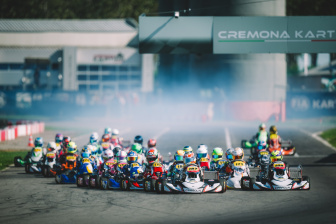
It is increasingly common for the running order under the chequered flag not to match the final classification, with penalties imposed after the race, almost always for issues related to race contacts, front fairings and dangerous driving assessed retrospectively. We tried to ask drivers, former drivers and long time managers what they think about it… (ls)

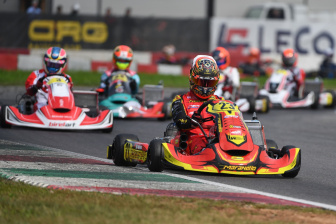
Both in the preparatory Round of the Champions of the Future series and during the third Round of the OK and OKJ European Championship in Mulsen, we witnessed very hard-fought races, but also a series of post-race classification shake-ups that are almost unprecedented: 14 penalties in a single Final (not to mention what happened in the heats) are really a lot when we are talking about the highest level this sport has to offer, and things are not much different in KZ – anyone who saw (and raced) the Genk events knows exactly what we are talking about. The conduct of several drivers (here we are not focusing on a single episode, we are not interested in blaming one driver rather than others) has been at the so‑called limits of the regulations: but then, what actually are the “limits of the regulations”, one might ask, and above all: is it really possible that everything has to be deferred to after the race?
No, it’s not the anti-launch
In cases like this, it would be all too easy to point to the bodywork as the reason behind this phenomenon and thus make it the only scapegoat, but although doubts have been raised on these very pages about some of the solutions, we do not consider it fair to shift the focus entirely onto them – also because if this is the path chosen by the FIA for contact safety, it has to be acknowledged and the focus must shift to everything around it. The problem seems to lie more in the race conduct of the drivers who, perhaps also thanks to the configuration of modern karts (which greatly limits the chances of a “serious” accident when two karts touch), take advantage of a set of regulations that punishes unsporting moves almost exclusively at the end of the race and therefore somehow encourages drivers to give it a try. When they are not outright unsporting, the moves are “cunning”, and when they are not cunning, they may appear unintentional or be declassified as normal race contacts; the point is that the penalty, when it comes, comes at the end of the race, sometimes when the podium photos have already been posted on social media. Why are we drawing attention to this seemingly minor detail? Well, let us take a look at how it works in other motorsport disciplines – and here too, unfortunately, F1 has not been a good influence on karting – and try to understand how the current disciplinary scenario could be improved.
.jpg)
The anti‑launch system "may" have influenced the race conduct of the more aggressive drivers but, it is up to Race Control to intervene promptly, ideally during the race itself
MotoGP and Formula 1
It is clear that the primary regulatory benchmarks for unsporting conduct by drivers are the two pinnacles of motorsport, and already at this level we can say that things work differently on two and four wheels: in MotoGP, for some years now, there has been the practice of the “Long Lap”, a type of penalty that forces the rider to follow an alternative, longer trajectory than the ideal racing line, in a specially designated area of the circuit. This entails a time loss of about 2–5 seconds, depending on the track, and is imposed in most cases while the race is in progress. It is almost never assigned directly, except in serious cases of unsporting behaviour, but is often preceded by a Warning, which the rider sees in real time on the bike’s dashboard or which is shown to him on a pit board by his team on the pit wall.
.jpg)
In motorcycle racing, MotoGP sets the guideline with regulations that punish riders in real time by forcing them into a long lap, which effectively puts the “undisciplined” rider out of the fight, a measure that is not feasible in karting, since the majority of circuits do not have a dedicated deceleration loop
In Formula 1, the presence of radio communications (absent in MotoGP, for now) changes things quite a bit and therefore something happens that is fairly similar to karting: Time Penalties (5 or 10 seconds) are the most common measure (assigned for light contacts, small advantages gained off‑track or unsafe releases in the pits). In these cases, the driver stops in the pits, with the mechanics standing still in front of the car for 5 or 10 seconds before starting any tyre change. If the driver does not pit again, the time is added to his final race time after the finish (which is basically what happens in karting, given that there are no pit stops in karting). Another disciplinary measure is the Drive‑Through, meaning the driver must enter the pit lane, drive through it respecting the speed limit and rejoin the track without being allowed to stop for a tyre change, which usually results in a loss of between 20 and 25 seconds. The sequence ends with the Stop and Go (10 seconds), the harshest in‑race penalty before disqualification. The disciplinary escalation here too starts from a Warning, which – thanks above all to technology – is signalled to the driver via the display on the steering wheel, where a warning light comes on or a specific message appears, possibly backed up by radio messages, in addition to the light panels that in F1 have replaced human flag marshals. In Superbike, things obviously work in a very similar way to MotoGP, while in Motocross, where contact is common and where there is in some cases a serious risk to the riders’ safety, measures are taken immediately: we are talking about dropping positions and possibly black flags for anyone who physically hits the bike or the opponent with their own bike – excluding, of course, racing incidents and the somewhat “rougher” conduct that sports like this entail. If we look across the ocean, penalties for behaviour are very severe and involve a series of measures ranging from dropping to the back of the field in the event of a safety‑car period to mandatory pit stops of up to 30 seconds. In all these cases, whether it is F1, MotoGP or IndyCar, decisions are made by the stewards, who obviously have eyes on the entire track thanks to sophisticated video surveillance systems covering every corner of the circuit with high‑resolution cameras.
(1).jpg)
In Formula 1, a former driver (on a rotating basis) is part of the group of stewards who support Race Control in decision‑making, drawing on their previous experience as drivers. Vitantonio Liuzzi is among those chosen for the 2026 season. So far, in karting, there are no former professional drivers among the stewards
The right timing as a solution? Yes, but circuits choice matter too
Karting, unlike the disciplines mentioned above, relies on a regulation that is both a deterrent and a sanction: the one related to the front fairing and its mounting system which, in the event of an excessive impact – thus intentional, in most cases, on the part of the following driver – becomes misaligned, creating a visible trace of the unsporting behaviour that is detected when the drivers arrive in parc fermé and allows the stewards to impose penalties that generally amount to 5 seconds added to the driver’s final race time, often depriving them of victory or a podium. But is it really effective if applied only in this way? What happens on track, and what we have discussed with a range of people in our paddock (drivers, former drivers, team managers whom we will not name here, because the aim is not to create division with public statements but to try to find a solution), has led us to conclude that no, it is not enough, or at least that perhaps everything hinges on the timeliness of warnings from Race Control to the drivers and on the sanctions themselves being applied during the race and not afterwards.
.jpg)
Nothing compares to correct use of the Black‑and‑White flag (warning addressed to a specific driver) and the Black flag (immediate disqualification) in karting, given the short duration of the races and the immediacy of the effects
We are mostly talking about very young drivers, but even when it comes to seasoned KZ drivers, we know full well that it is absolutely not easy to enforce the rules and that these sports involve higher levels of aggressiveness than perhaps other disciplines. They are individual sports, where essentially the driver ultimately does things entirely his own way; it is not easy at all, we know this and we do not want to oversimplify, but there is a way to move towards Race Control that is not only stricter, but above all more active in real time with respect to how the race is unfolding. Starting from the heats, disciplinary measures such as a black flag can put the driver in a position to assess themselves honestly and to continue the event aware that actions have consequences, and this will inevitably lead all drivers to reassess both the room they leave for manoeuvres and the way they approach the fight: cameras are operating during the race and marshals are all in radio contact, so it is true: in karting we do not have long laps and the races are very short, but we do have flags, especially the black‑and‑white and the black flag, which nowadays are used very little. It is not about stripping the sport of a core component of its nature, but rather about refining its educational value, which after all, especially in the context of FIA events (which it must be said are sometimes held on facilities that are not exactly ideal for the high level of these competitions), should be shaping professionals who will then go on to race predominantly in single‑seater open‑wheel cars.
.png)
At the latest edition of the Supernats in Las Vegas, there was no shortage of tense moments due to the many on‑track contacts between drivers – which makes the stewards’ job extremely difficult, even though today, compared with the past, they can rely on closed‑circuit camera systems to monitor every single centimetre of the track while the race is underway
We have already discussed how some “growing pains” of certain drivers coming from karting have created very dangerous situations in F4 as well and elsewhere, perhaps because the racecraft of modern karting is just a bit too aggressive when drivers step into almost 300‑hp single‑seaters. But the problem is endemic and also affects one‑make series and national championships, as well as rental races, and any context where drivers face off on track without Race Control taking the reins of the problem in time: in time on track, in real time and with the right‑coloured flags, but also in time in a broader sense, across the whole picture, so that karting can maintain the credibility it deserves and does not become a sport in which the most reckless drivers are given too much latitude.
Browse Related Articles
FIA Karting


Races
16/09/26


Races
03/08/26

Races
06/07/26

Articles selected for you


Races
05/10/26

Races
29/09/26