Club100 was born from an idea by John Vigor, who, after a long experience in organizing rental and endurance races, decided to create a championship where people could race without worrying about maintaining their own kart. You see, karting is a beautiful sport, but also a significant personal commitment: you need space at home to store it, a van to transport it to the track, a friend to help lift it on and off the trolley, and lots of time before and after the race to clean, disassemble, and put everything back in order. These are all things the crew takes care of at the track. Indeed, all I had to think about on an unusually sunny September morning in Northamptonshire was not to forget my helmet and racesuit at the hotel after breakfast.
The karts awaited us at the circuit, where the Club100 mechanics were making final adjustments after a rainy event in Wales two weeks earlier. As a good Italian, my first concern looking at the island's highly variable sky was the weather, so I asked John about one of the Championship's quirks that I feared was true, and he confirmed it: in case of rain, you race with slicks. As he reiterated, "it sorts the men out from the boys". Well, after all, coming here and not racing in the wet is like going to Naples and not have a pizza.
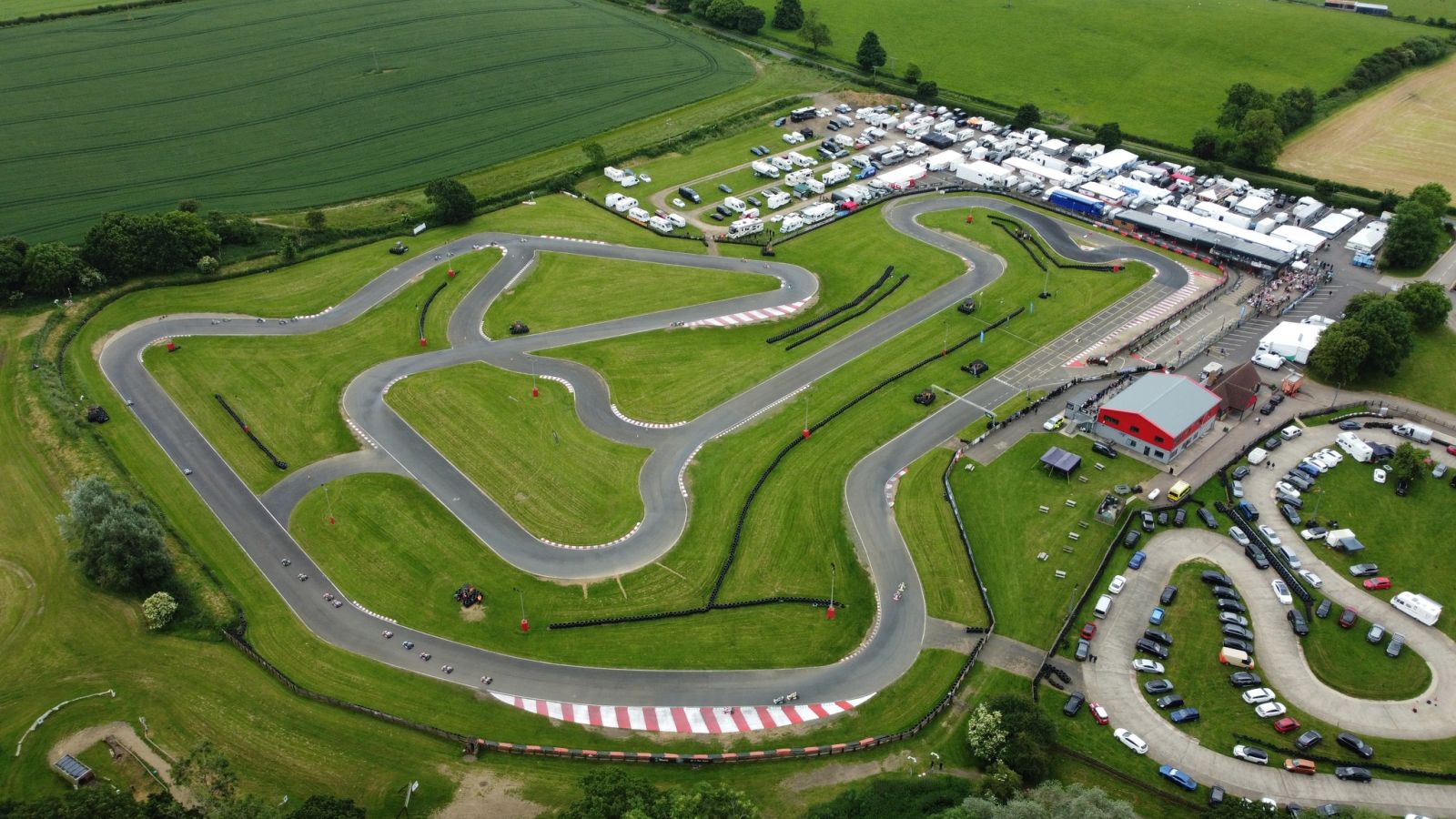
Whoever you are, whether you're a licensed driver of any ASN, a former F1 World Champion (Damon Hill raced here for an entire season), or it's your first time ever in a two-stroke kart, new entrants must undergo a rookie test preceded by a very detailed briefing about this type of racing. In my case, I was alongside people with some experience in rental races, SIM racing enthusiasts, others who knew what they were doing, but there were also complete beginners and some trying for the umpteenth time. Because the organizers may not admit you to the Championship if your control over the kart, discipline in avoiding contact, respect for flags, and average lap times are not up to par with a competition featuring two-stroke karts. The test lasts 30 minutes and allowed me to familiarize myself with the kart (Birel N35X chassis, Rotax Junior 125 engine with a 34mm fixed jet Dellorto carburetor) as well as with this beautiful track, owned by a local farmer. The layout was recently modified for safety reasons: where there was once a fast right-hander, there is now a tight chicane leading onto the main straight, reminiscent the one in the old Parma circuit. Once through, you flat out and don't lift for a long time. After the finish line, a very fast "S" leads onto the track’s longest straight. You exit the “S” very wide, often with at least two wheels on the curb, about which John was clear: if you go over it with all four wheels, you'll get a track limits penalty. At the end of the long straight, where you can go three-wide and choose various lines into the following right-left section, there’s a heavy braking zone, perhaps the only significant one of the whole lap. From there, the track becomes more twisty until it brings you back to the chicane leading onto the main straight. It’s in that technical section that you realize why British drivers are so skilled; growing up on tracks like this, which combine daring high-speed sections with highly technical ones, it’s tough to stay within a decent gap of the local drivers. Despite this, the test went very well, I fell in love with the track, and I was more than respectably admitted to the next day's races.
There was a girl among the participants who spun out a few times but kept getting back on track with determination. Unfortunately, she didn’t qualify. It wasn’t her first failed attempt, but she promised everyone that she’d be back next time and reach her goals. Her spirit deeply impressed me, as did the great encouragement she received from so many here, for whom she has become an icon. I think she represents what these races are all about and the wide range of people they appeal to.
The karts awaited us at the circuit, where the Club100 mechanics were making final adjustments after a rainy event in Wales two weeks earlier. As a good Italian, my first concern looking at the island's highly variable sky was the weather, so I asked John about one of the Championship's quirks that I feared was true, and he confirmed it: in case of rain, you race with slicks. As he reiterated, "it sorts the men out from the boys". Well, after all, coming here and not racing in the wet is like going to Naples and not have a pizza.
Whoever you are, whether you're a licensed driver of any ASN, a former F1 World Champion (Damon Hill raced here for an entire season), or it's your first time ever in a two-stroke kart, new entrants must undergo a rookie test preceded by a very detailed briefing about this type of racing. In my case, I was alongside people with some experience in rental races, SIM racing enthusiasts, others who knew what they were doing, but there were also complete beginners and some trying for the umpteenth time. Because the organizers may not admit you to the Championship if your control over the kart, discipline in avoiding contact, respect for flags, and average lap times are not up to par with a competition featuring two-stroke karts. The test lasts 30 minutes and allowed me to familiarize myself with the kart (Birel N35X chassis, Rotax Junior 125 engine with a 34mm fixed jet Dellorto carburetor) as well as with this beautiful track, owned by a local farmer. The layout was recently modified for safety reasons: where there was once a fast right-hander, there is now a tight chicane leading onto the main straight, reminiscent the one in the old Parma circuit. Once through, you flat out and don't lift for a long time. After the finish line, a very fast "S" leads onto the track’s longest straight. You exit the “S” very wide, often with at least two wheels on the curb, about which John was clear: if you go over it with all four wheels, you'll get a track limits penalty. At the end of the long straight, where you can go three-wide and choose various lines into the following right-left section, there’s a heavy braking zone, perhaps the only significant one of the whole lap. From there, the track becomes more twisty until it brings you back to the chicane leading onto the main straight. It’s in that technical section that you realize why British drivers are so skilled; growing up on tracks like this, which combine daring high-speed sections with highly technical ones, it’s tough to stay within a decent gap of the local drivers. Despite this, the test went very well, I fell in love with the track, and I was more than respectably admitted to the next day's races.
Advertising
Advertising
Advertising
There was a girl among the participants who spun out a few times but kept getting back on track with determination. Unfortunately, she didn’t qualify. It wasn’t her first failed attempt, but she promised everyone that she’d be back next time and reach her goals. Her spirit deeply impressed me, as did the great encouragement she received from so many here, for whom she has become an icon. I think she represents what these races are all about and the wide range of people they appeal to.
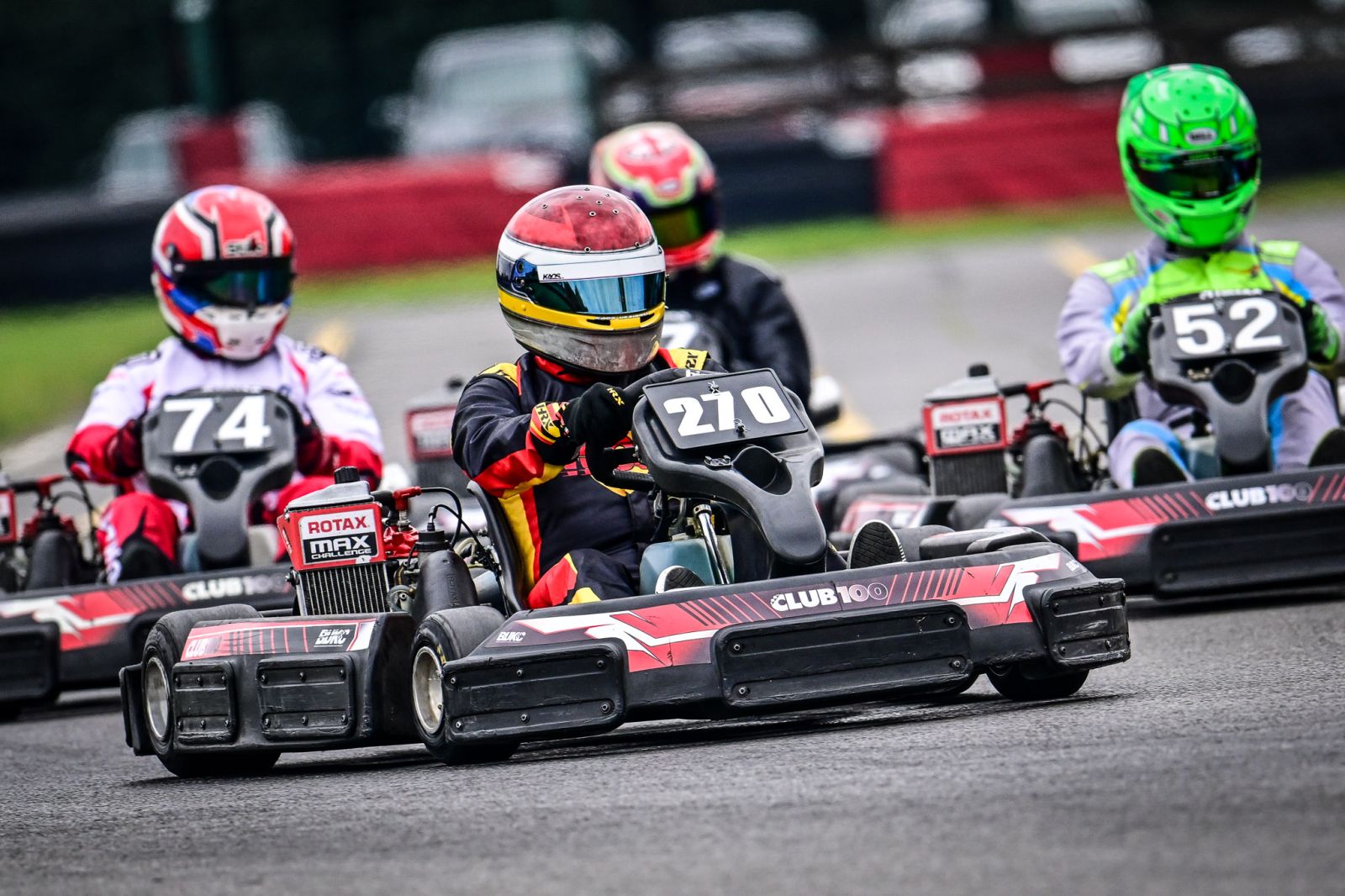
The tussle in Club100 is very fair, not something you can take for granted in closed-wheel racing
The races for me were on Sunday, and for obvious reasons, I competed in the Light category, where the weight each driver must reach (either naturally or with ballast attached to the chassis) is 78 kg. In the Heavy category, the minimum weight is 90 kg. There are no qualifying sessions, and grid positions are assigned randomly, with newcomers starting in the last three rows by rule. Even if you’re a driving phenomenon, don’t worry—you can make your way to the front without problems, thanks to the great respect for the rules you see in these races. The purpose of the heats is to determine the starting grids for the Finals. Each driver competes in three heats, which produce an overall score that allows the organizers, using the Alpha Timing platform, to create three different finals based on the rankings generated by the heats. Some drivers, namely the winners of the B and C finals, can ‘crossover’ and race in the next final, essentially giving them one extra (sometimes, two) race.
In my first two heats—where I started at the back by rule—everything went smoothly, and I managed to gain some positions, having fun in the battles. With dry weather holding up, I began to learn the circuit’s secrets and truly started enjoying myself. You know, two-stroke engines offer unique sensations, especially in acceleration and the first part of the track. Wow, the “S” at Whilton Mill is something to experience; I highly recommend it. The hard-compound Dunlop tires also help less fast drivers like me and are perfectly suited for this type of racing. What struck me, given my Italian background, was the fairness of the drivers: there’s aggression, but I didn’t see, either in my heats or in others that I watched from the stands, that unpleasant "demolition derby" effect that sometimes occurs when racing with more robust chassis and covered wheels. We discussed this at length with the organizers, and it’s a side effect of very strict regulations, enforced by two people in the control room who remain in constant communication with marshals around the track, assigning warnings and penalties in real-time, which, given the competitiveness of many drivers, can even change the outcome of the race.
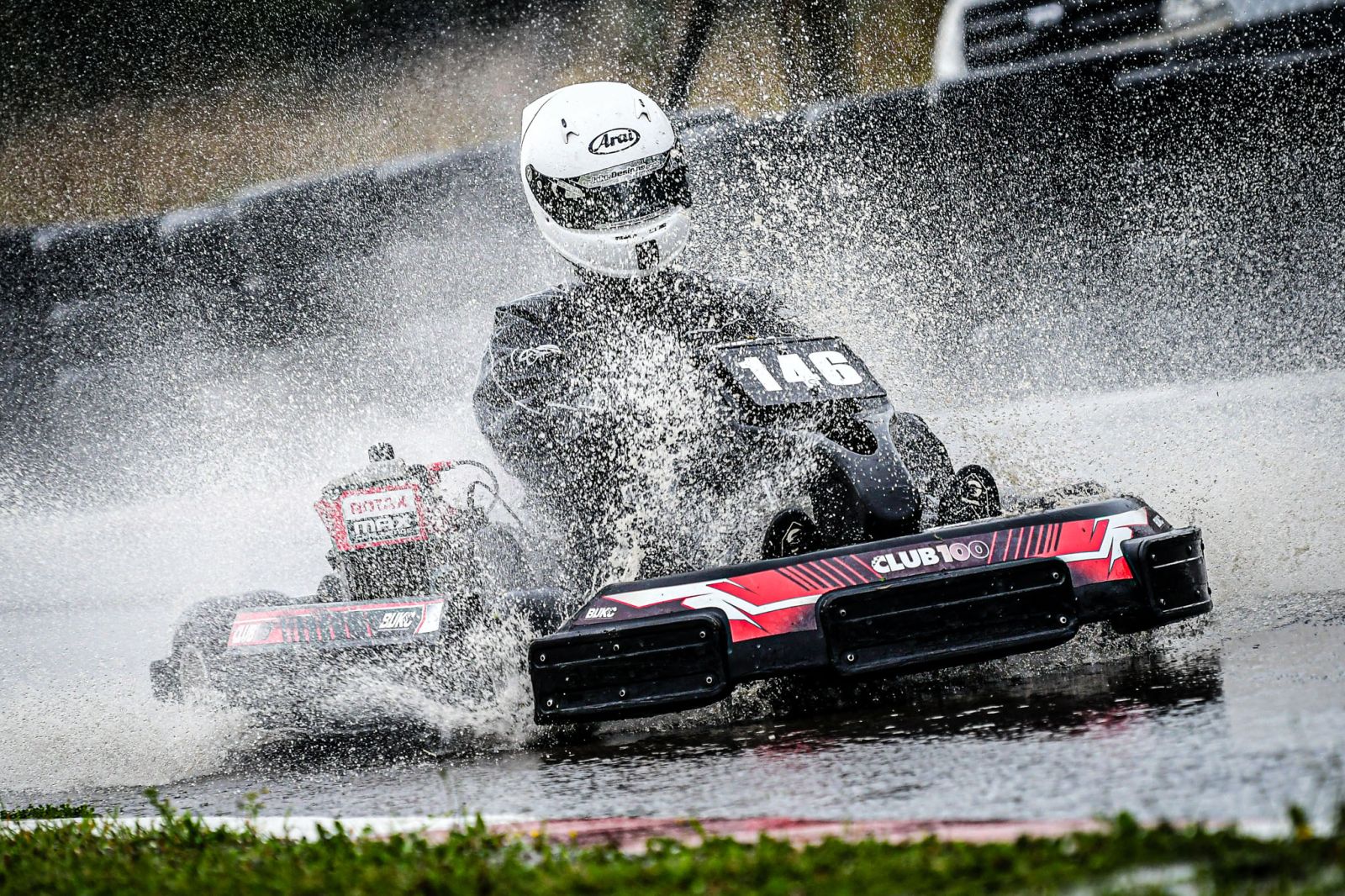
On a wet track, racing is with slick tires
Back to my race: the announced rain arrived timidly during the third heat and heavily for the final, just as we were lining up on the pre-grid. At that point—at least for me—the goal was simply to finish the race respectably. Racing with slicks (changing tires in such a large fleet of karts would disrupt the timing, especially in a place where the weather changes so frequently like England) increased the challenge but also the sense of accomplishment. The rules are clear for anyone who spins off into the grass: you get out of the kart, push it back onto the track by yourself, and resume racing—no revving the engine uselessly or straining the clutch. At first, I had a lot of fun, managing—by avoiding the rubbered-in line and putting the wheels exactly opposite to where I had on the dry—to set decent lap times and stay relatively close. But inevitably, my first major spin, caused by pushing too hard for my wet-weather skill level, dampened my enthusiasm. I restarted but more cautiously, especially as the rain intensified. On track, I found myself dueling with a friendly but fast 63-year-old university librarian who has been racing here for thirty years. We had chatted amicably before the start, and now we were battling it out on track. The checkered flag finally came, just as the English sky taunted me with a glimpse of sunshine breaking through the clouds. As I brought my 13 kg of ballast back to parc fermé, I was grateful to John and his partner Will Tew for their hospitality and certain that this type of karting is truly accessible to any kind of motorsport enthusiast.